Why Writing Your Own Vows Is Worth the Effort
Written wedding vows are the one element of the ceremony that is genuinely yours. The officiant has a script. The music was chosen to fit the venue. The readings came from a book. But the vows you write and speak are the words your partner will hear — and remember — as the defining moment of your wedding ceremony. When vows land well, they become the moment guests remember first when they think back on your wedding.
But writing your own vows is also harder than most couples expect. The blank page is intimidating. The pressure to say something meaningful in front of family makes people freeze. The temptation to copy structure from a template produces vows that feel generic. The framework below breaks the process into specific steps — from the prompts that unlock real content to the delivery techniques that help you speak them well — so the final result is actually yours rather than a formula.
Step 1: Set the Parameters Together
Before writing, align with your partner on the specifics. The conversations to have:
- Length: 1 to 2 minutes each is the sweet spot. Less feels rushed; more tests guest patience. Pick a target length and commit.
- Tone: funny, serious, or mixed? The vows should match each person's natural voice — if one partner is playful and the other is serious, their vows can differ in tone without feeling mismatched.
- Content boundaries: anything that is off-limits? Private promises that will not be made public, inside jokes that guests will not understand, specific stories that feel too raw for a group setting.
- Reveal: will you share vows with each other before the ceremony, or hear them fresh in the moment? Roughly half of couples share in advance; the other half don't.
- Structure: are there specific promises or elements you both want to include? (Many couples include a 'I promise' section, but structure is flexible.)
These conversations 2 to 3 months before the wedding set expectations and reduce last-minute friction.
Step 2: Use the Prompts That Unlock Content
The blank page is the enemy of good vows. Use specific prompts to generate raw material that you can later shape. Sit with a notebook and answer these questions:
- When did you first realize you loved this person?
- What do they do that makes you feel safe?
- What specific moment from your relationship do you return to in memory?
- What do you admire about them that they might not realize you notice?
- What is one thing about your partner that has changed you?
- What do you promise to do — not abstractly, but specifically?
- What do you hope is true of your marriage in 20 years?
- What do you promise to keep showing up for when life gets hard?
Write freely. The goal of this step is material, not polish. Most couples generate 3 to 5 pages of raw content that gets distilled into the final 1-to-2-minute vows.
Step 3: Find the Structure That Carries Your Content
Good vows usually follow one of four structures. Pick the one that fits your material:
- 'Why I love you / what I promise' — starts with a paragraph about your partner, then transitions to specific promises. The most common and reliable structure.
- Memory-based — opens with a specific story (a first date, a moment you knew), pivots to what that moment revealed, closes with promises.
- Letter format — addressed directly to your partner, structured as things you want them to know. Intimate and personal.
- Question-and-answer — poses a question ('What have I learned about love in our years together?'), answers it, and promises to keep learning.
Structure is the skeleton; your answers from Step 2 are the muscle. Write the first draft in the structure you chose, keeping it loose. The first draft will be too long and too raw — that is fine.
Step 4: Edit for the Reader, Not for Yourself
Once you have a draft, edit it with a specific lens: your partner hearing it in front of family and friends. The edits to make:
- Cut anything that requires context your partner has not provided publicly
- Cut inside jokes that guests cannot understand
- Cut anything that sounds generic (phrases like 'you complete me' or 'you are my rock' have no specific meaning)
- Add specific, sensory details wherever you can (not 'you make me laugh' — name the specific thing they do that makes you laugh)
- Read it aloud. If a sentence feels awkward spoken, rewrite it
- Time yourself. If you are over 2 minutes, cut the weakest paragraph
The goal is vows that sound like you, not like you are trying to sound meaningful. The most memorable vows are often the simplest and most specific — the ones that capture something true about the relationship rather than something that could be true about any relationship.
Step 5: Practice Out Loud, Multiple Times
Reading your vows silently is not enough. The mouth needs to practice the words at least 5 to 10 times before the wedding day. What to practice for:
- Pacing: where to pause, where to slow down, where to speed up
- Emotional moments: where you are likely to choke up. Mark those in the text so you can anticipate them
- Breathing: place breath marks in the text at natural pause points
- Volume: practice speaking loudly enough for the back of the venue to hear
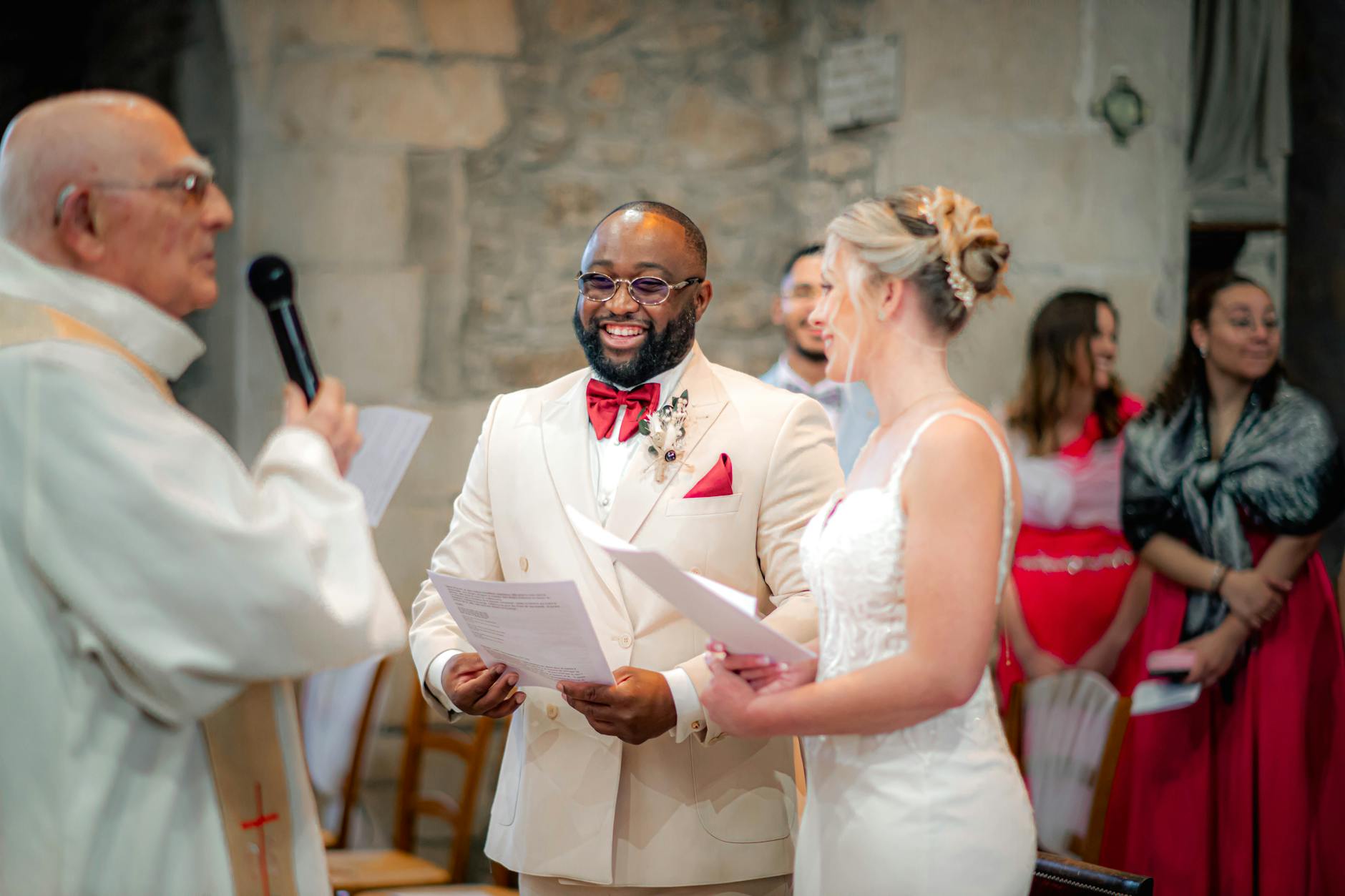
- Looking up: practice the cadence of looking at the page and then up at your partner
Practice in front of a mirror first, then in front of a trusted friend or family member, then in front of your partner (if you are sharing in advance). Each practice identifies different rough spots.
Step 6: The Day-Of Logistics
Even the best-written vows can fall apart in the emotion of the moment. Plan for this:
- Print vows on high-quality paper that feels substantial in your hand — not folded-up notebook paper
- Print in a large, readable font (14-16 point) with generous line spacing
- Have a backup copy in case the primary gets lost or damaged
- Give a copy to the officiant — if you freeze, they can prompt you from memory
- Pack tissues somewhere accessible
- Practice the transition: how do you pull out the vows, unfold them, speak them, and put them away?
- Slow down. The biggest delivery mistake is rushing. A short pause between paragraphs helps guests absorb the moment.
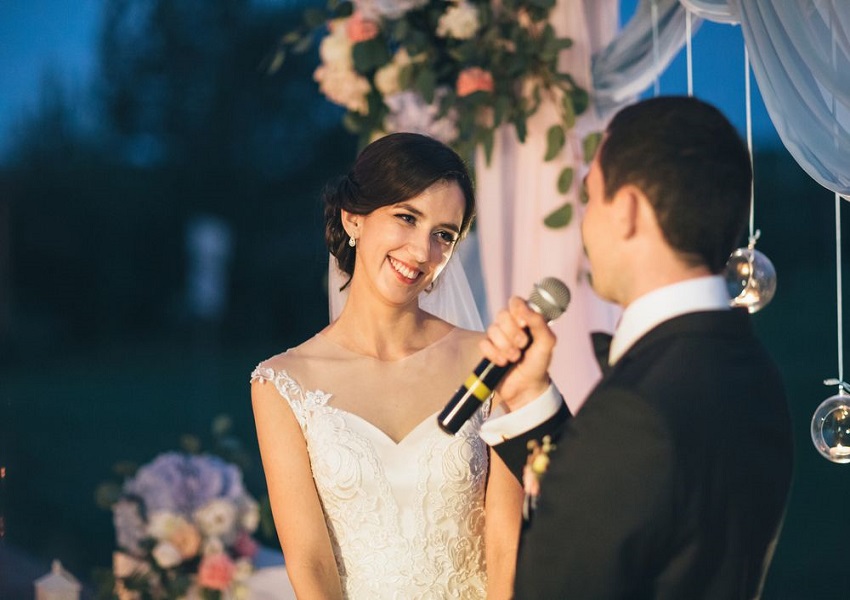
When you speak them, look at your partner, not at the guests. The vows are addressed to your partner; the guests are only witnesses.
Common Vow-Writing Pitfalls
What typically goes wrong:
- Writing vows in the final week — leads to generic or frantic content
- Trying to be funny for the guests rather than for your partner
- Including promises that feel abstract rather than specific
- Reading in a monotone rather than with emotional pacing
- Forgetting that the vows are for your partner, not a performance for the audience
- Attempting to summarize the whole relationship rather than focusing on 2 or 3 specific things
- Writing the same vows your partner is writing (if sharing in advance, find the complementary approach rather than echoing each other)
The vows you will be happiest with 20 years from now are not the ones that impressed the guests the most. They are the ones that genuinely captured who you were and what you promised at that specific moment in your life together. Write for that.