Wedding Day Makeup Guide for 2026 Brides


What Wedding Day Makeup Actually Needs to Do
Wedding day makeup has two jobs: make you look like your most rested, polished self in person, and hold up on camera across a 10-to-14-hour day. Those two jobs sound simple, but they require different choices than everyday makeup. Daily makeup is designed for regular lighting and 8 hours of wear. Wedding makeup needs to work in photographs, withstand flash, survive happy tears, and stay vivid for a full event day.
The guide below covers the wedding-morning routine, the trial process, the products and techniques that consistently photograph well, and the common mistakes that make brides look overly made-up or underdone. Whether you are hiring a professional artist or doing your own makeup, the same principles apply. The goal is not 'more makeup than everyday' — it is 'the right makeup for the camera.'
DIY vs Professional Artist: The Honest Trade-Off
Two paths work for wedding-day makeup: a professional artist or DIY. Neither is inherently better.
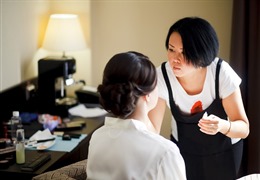
Hire a professional artist if: you do not wear heavy makeup regularly, you have not practiced your wedding look extensively, you want a dramatic eye or lip that requires skill to execute, you are photographing extensively for editorial-style images, or you simply want the morning to be stress-free. Cost: $250 to $600 for the bride; $150 to $350 per bridesmaid; trial fees $150 to $400. Tips and travel additional.
DIY makeup works if: you wear makeup confidently daily, you have practiced your specific wedding-day look at least 3 times, you have done a full trial with photographs in different lighting, and you enjoy the morning ritual of doing your own makeup. DIY savings: $300 to $600 depending on what you are replacing.
Hybrid: use a professional for just the bride, DIY for the bridesmaids. Or vice versa — DIY the bride with a trusted friend, hire pros for a few of the bridesmaids. Many couples do hybrid in 2026.
The Makeup Trial: The Single Most Important Appointment
The trial is where everything is decided. Book it 4 to 8 weeks before the wedding, not in the final month. What to bring to the trial:
- A photo of your wedding dress, particularly showing the neckline
- Inspiration images: 3 to 5 photos of makeup looks you like
- Your own signature lipstick or favorite daily makeup pieces
- A fully-styled test outfit (not the dress, but something similar in tone)
- A willingness to try the full look — not a watered-down version
During the trial: take photos throughout with both natural light and flash. Photograph from multiple angles (front, three-quarter, side). Step outside to see how the makeup reads in sunlight. Sit by a window. Look at all photos before deciding. What looks good in the salon mirror often looks different in camera — and camera is what the wedding gallery will capture.
After the trial: wear the makeup the rest of the day. Live in it. Note where it breaks down — does it transfer? does the eyeshadow crease? does the lipstick fade? That information shapes the wedding-morning adjustments.
Skin Preparation Starts Weeks Before
Good wedding makeup starts with skin that has been prepared for weeks, not hours. The skincare calendar:
- 3 months out: start a consistent skincare routine. Address specific issues (acne, texture, hyperpigmentation) with a dermatologist if needed.
- 2 months out: book a series of 2 to 3 facials with an experienced esthetician.
- 1 month out: stop introducing new products. Skin needs stability heading into the wedding.
- 2 weeks out: final gentle facial — calming, no extractions, no peels.
- 1 week out: nothing new. Normal routine only. Drink 2 to 3 liters of water daily.
- Wedding morning: gentle cleanse, light moisturizer, SPF. Avoid any new products.
The bride with well-prepared skin needs significantly less foundation and concealer on the wedding day — and the lighter makeup application photographs more naturally than heavy coverage on neglected skin.
The Techniques That Photograph Beautifully
Specific technique choices that consistently produce flattering wedding-day photos:
- Foundation: one shade deeper than your daily foundation in color-test (photography washes out skin tone). Apply with a damp sponge for a natural finish.
- Blush: warmer and slightly more saturated than daily. Place on the apples of the cheeks and blend up toward the temple.
- Bronzer: subtle contour under the cheekbone and at the hairline. Avoid heavy contouring — it ages quickly in photos and reads dated within 5 years.
- Eyes: defined with liner and mascara, but not dramatic. A soft neutral smoky eye with well-applied mascara outperforms a heavy colored eye look in most wedding settings.
- Lashes: strip falsies or individual lashes are the most impactful single makeup upgrade for photos. Even brides who do not normally wear lashes benefit from them on the wedding day.
- Lips: a color you already wear and know lasts. Wedding day is not the time to discover that a new red lipstick bleeds into your lip liner.
- Setting: setting spray + setting powder = 12+ hour wear. Do both.
- Highlighter: used subtly on the tops of cheekbones and the brow bone. Avoid heavy glittery highlighter — it reflects flash and reads dated.
The Wedding Morning Routine
Time the makeup application carefully. For a bride with makeup taking 60 to 90 minutes, start 2 to 3 hours before getting into the dress. For bridesmaids' makeup (30 to 45 minutes each), plan the schedule so everyone finishes an hour before the ceremony.
Morning sequence that works:
- Eat breakfast before makeup starts (eating after risks smudging)
- Sip water regularly, with a straw if lipstick is applied
- Skin care and primer first, before any color
- Eyes before face (so eye fallout does not land on completed foundation)
- Lips last, with one final application 15 minutes before walking down the aisle
- Setting spray at the very end, held 12 inches from the face
Build in 30 minutes of 'just in case' time. Wedding mornings always run longer than expected; the makeup session is where that time gets found if it is needed.
Touch-Ups: What to Carry and When to Use Them
Wedding-day makeup needs touch-ups every 2 to 3 hours. Carry a small kit with:
- The lipstick or lip color used in the morning
- A small container of setting powder
- Blotting papers for shine control
- Mascara for any smudging (though good waterproof mascara usually survives)
- Setting spray (travel size) for mid-reception refresh
- A small mirror and makeup brush
Assign a bridesmaid (or the MOH) to carry this kit — not the bride. The bride should not be responsible for her own touch-up logistics during a high-emotion day. Natural touch-up windows: after the ceremony (before portraits), before dinner (after cocktail hour photos), before the reception grand entrance, before the first dance.
Common Mistakes to Avoid
The makeup mistakes most often regretted in wedding photos:
- Too much foundation — reads mask-like, ages the photos within years
- Heavy contour — dates photos to the specific makeup era
- Glittery eyeshadow — reflects flash harshly and reads tacky
- Bright blush poorly blended — causes 'clown cheek' appearance
- Lipstick outside natural lip line — reads overdrawn in close-up photos
- Overly dramatic eye + strong lip + heavy blush — pick two, not three
- Something completely different from daily makeup — reads like not-you
- Matte lipstick on dry lips — chapped and aged by hour five
- Skipping the trial in favor of 'we'll figure it out on the day' — guarantees disappointment
The bride who looks best in her wedding photos looks like her best self, not someone else. Keep the makeup aligned with your normal aesthetic but elevated 20 to 30 percent for the camera. That is the sweet spot that consistently ages well.